
Boulton's Birds - Part Three

The MAGPIE pattern
and its Borders
By Enoch Boulton
by Harvey Pettitwith border artwork by Barbara Anne Lee
This is the third in a series of sixteen articles on bird patterns introduced by Enoch Boulton during his tenure as designer and decorating manager at the Carlton Works from 1921/22 to 1930.
Below is an image of a Carlton Ware floating flower bowl with the MAGPIE pattern printed in black. The MAGPIE BORDER Bead decorates its in-curving rim, which helps prevent water spillage when moving the bowl to its desired spot, perhaps on a sideboard or dining table.
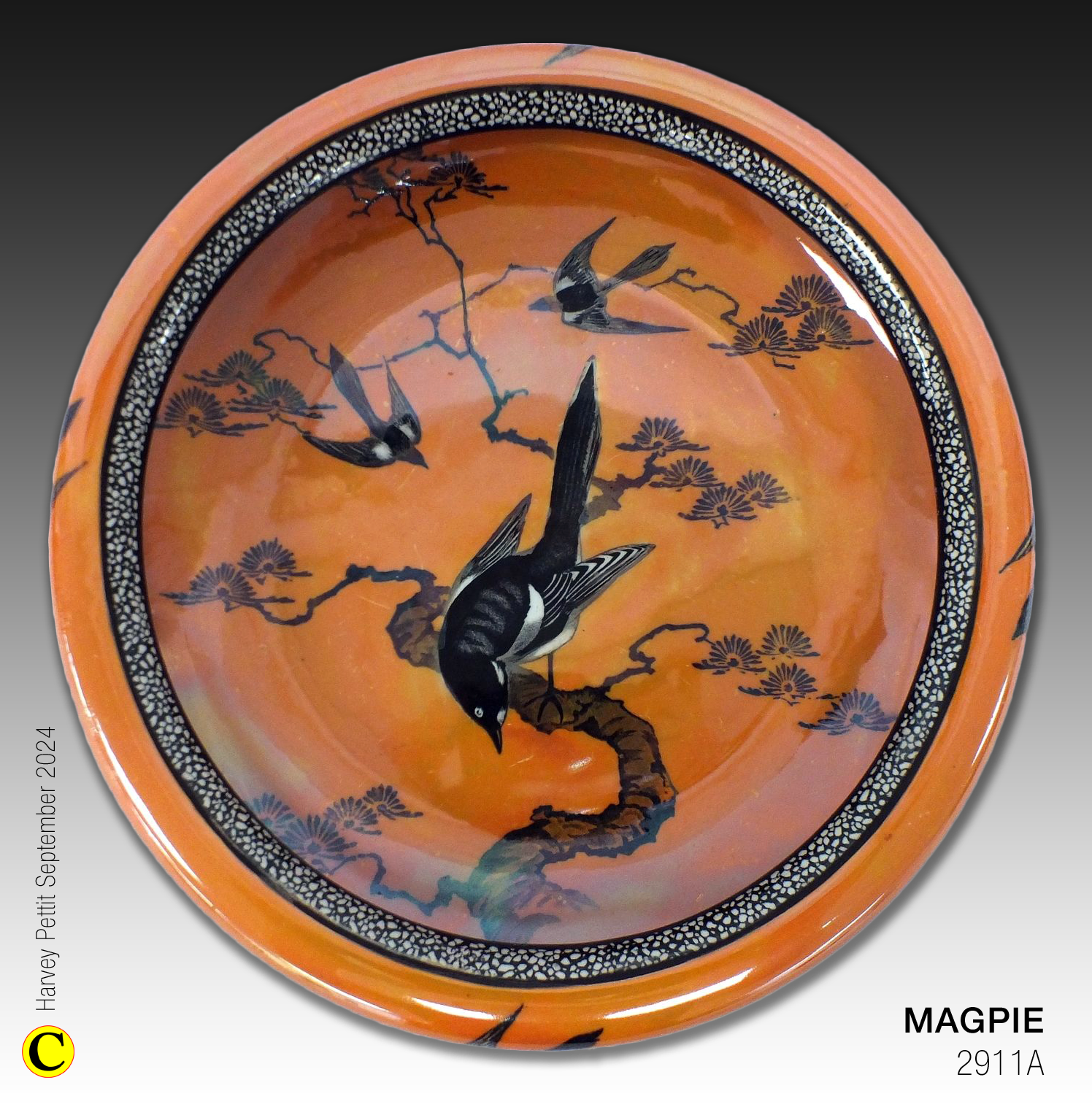
devised by Enoch Boulton and introduced in 1924.
To see this bowl fit your device's screen and/or enlarge,
click or tap on it.
To return to this page use your back button.
Striking Simplicity
Most versions of MAGPIE are simply printed in black. On that shown above, the corvid perched on the branch stands out against the rest of the pattern. This is because, cleverly, the bird has been masked from the ORANGE LUSTRINE that covers the rest of the pattern. The lustre coating mutes the branches and the birds in flight, pushing them further into the background and giving a three-dimensional effect. The border also escapes the lustre, making it stand out as well. If you enlarge the image by tapping or clicking on it, and then zoom in by tapping or clicking again, you can see this detail.
I estimate that
MAGPIE
was introduced in 1924. Sixteen variants were offered in its year of introduction,
with another three added some years later, giving buyers a total
of nineteen to choose from. Though most were printed in black,
two — 2912 and 2912A —
were reprinted in gold.
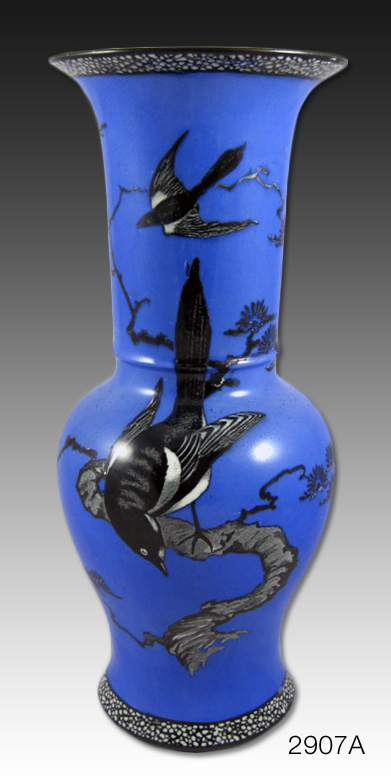
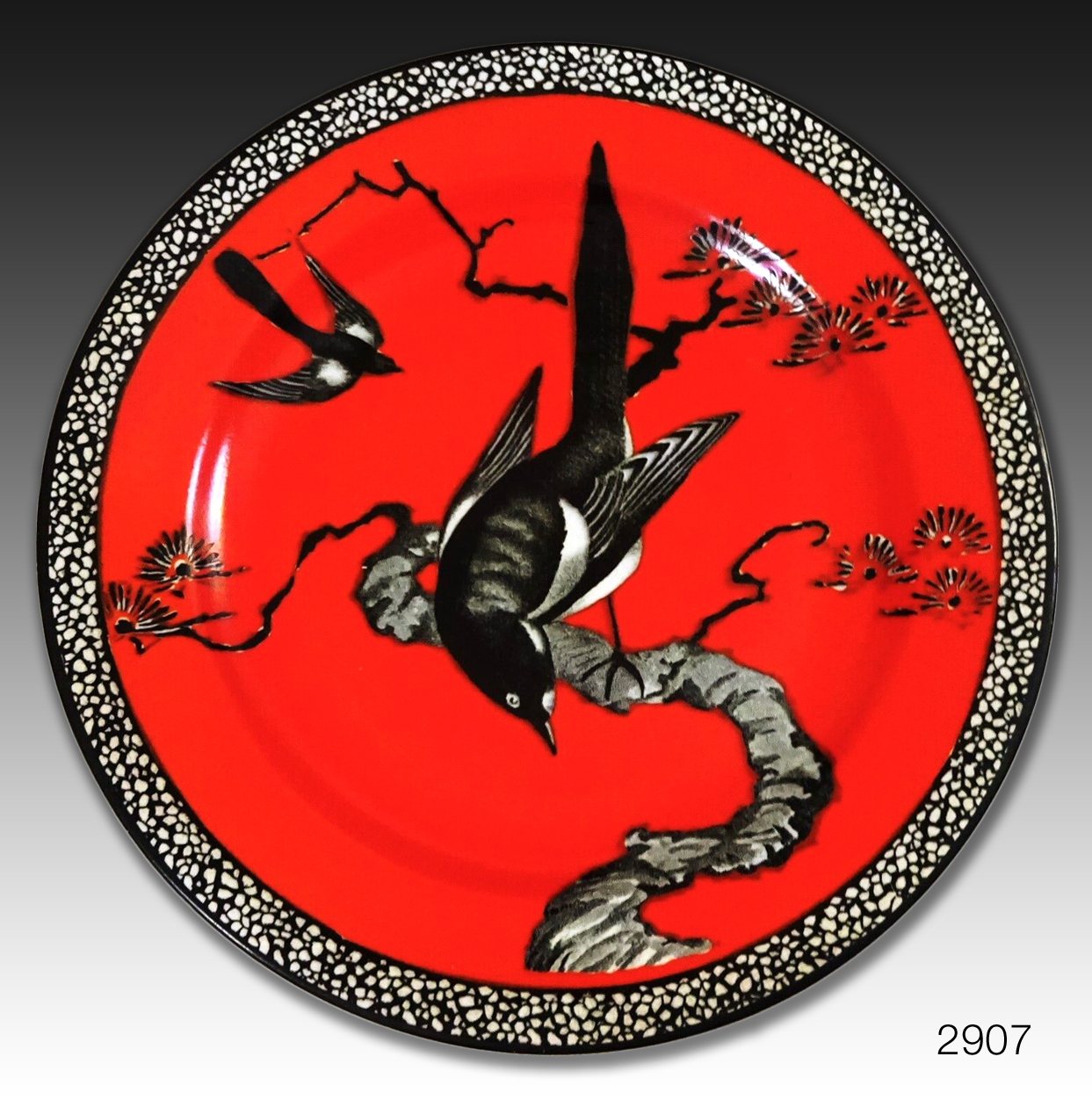
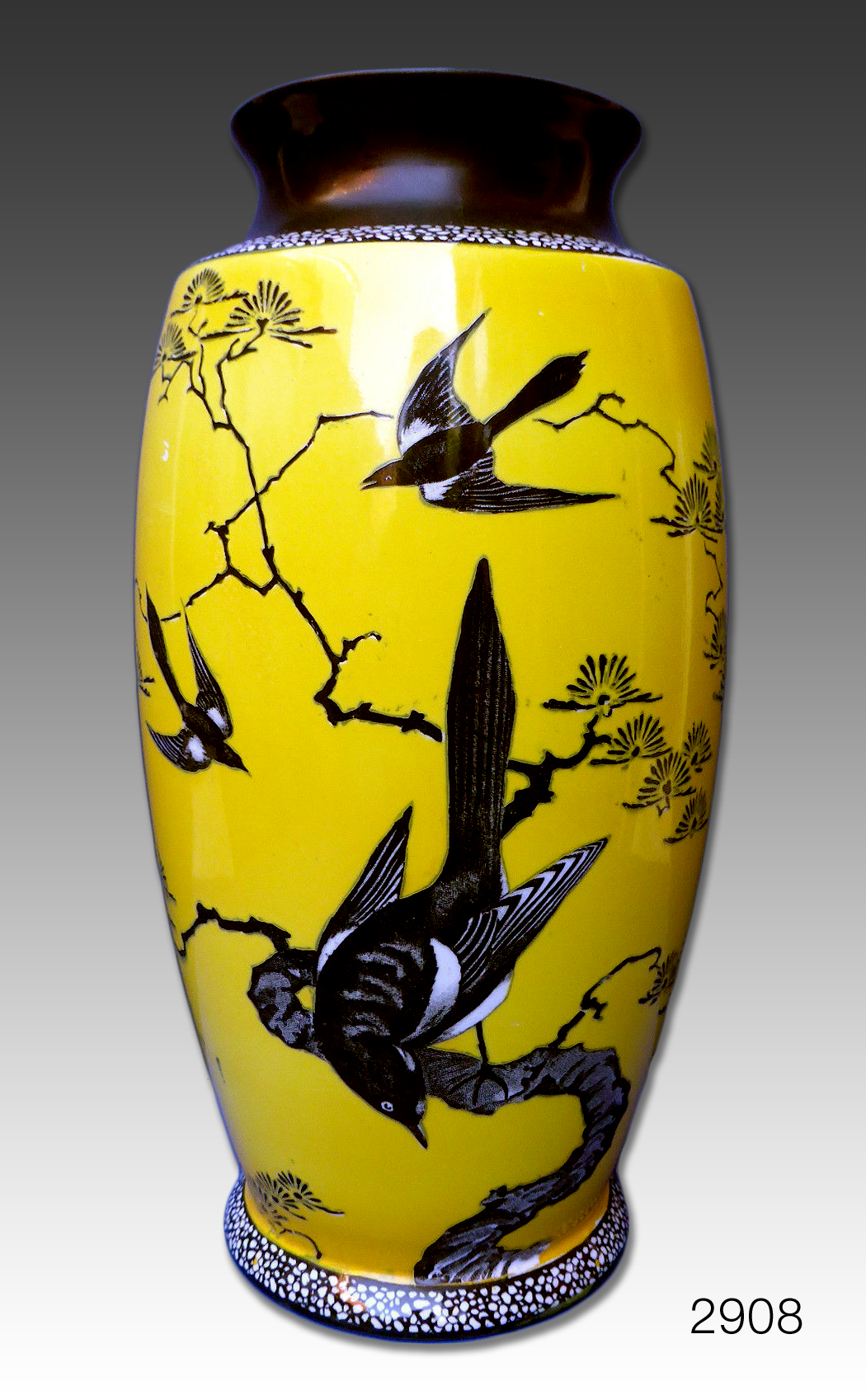
Below are three further
examples. On these, much of the
pattern print has been masked from the background so that it is not muted by the coloured ground. This must
have required a steady hand. By enlarging the image of the vase with the LEMON YELLOW
ground, you can see the margins between the print and the ground colour; where the yellow slightly overlaps the black,
the yellow it turns the print a soft grey.
To return to this page use your back button.
MAGPIE BORDERS
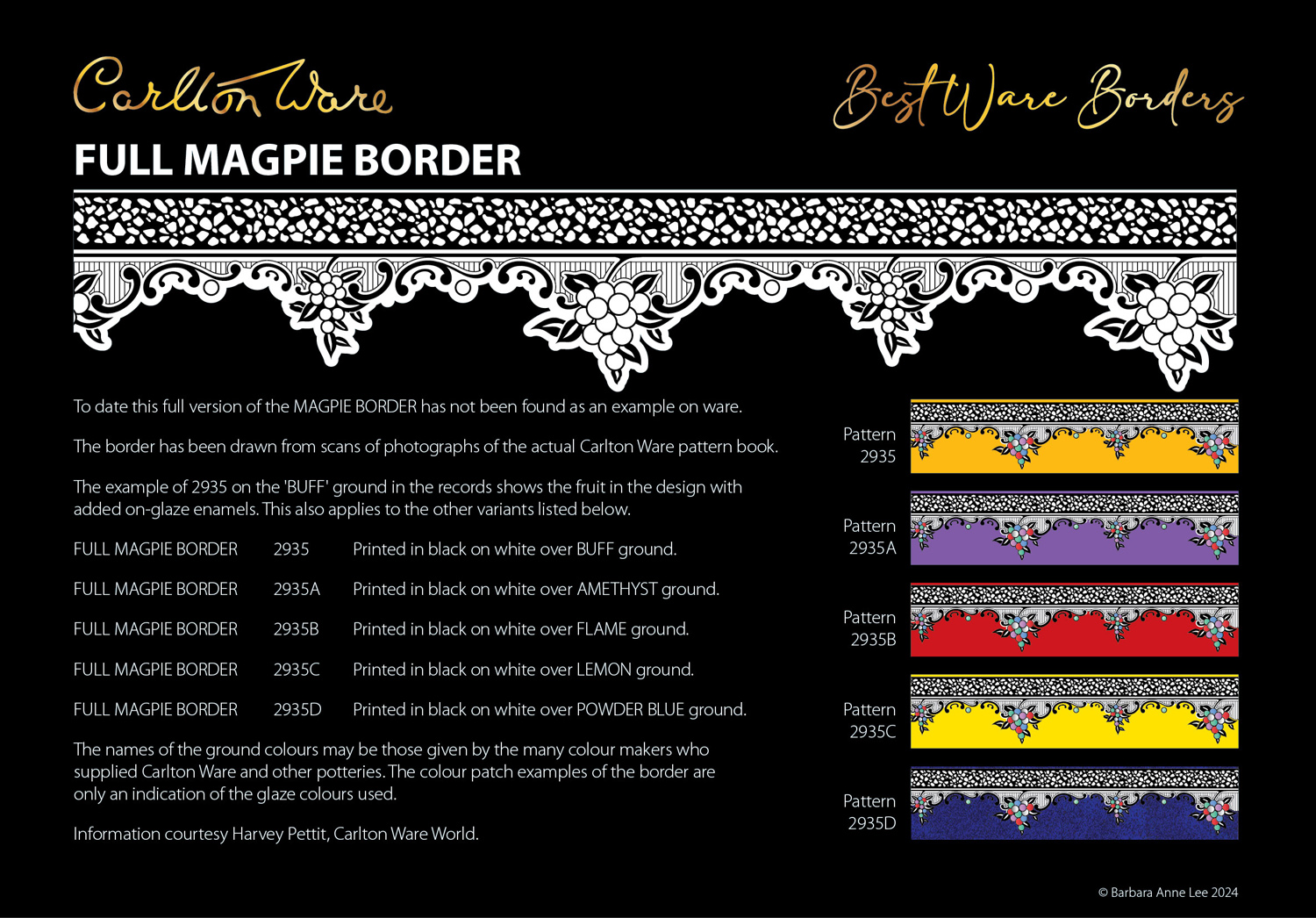
In Carlton Ware's pattern records, MAGPIE 2907 is shown with what was named the FULL MAGPIE BORDER. Working from a photograph of the entry in the pattern records, Barb has redrawn the border for us. However, I have not seen an example of such a border on ware. If you have, let us know.
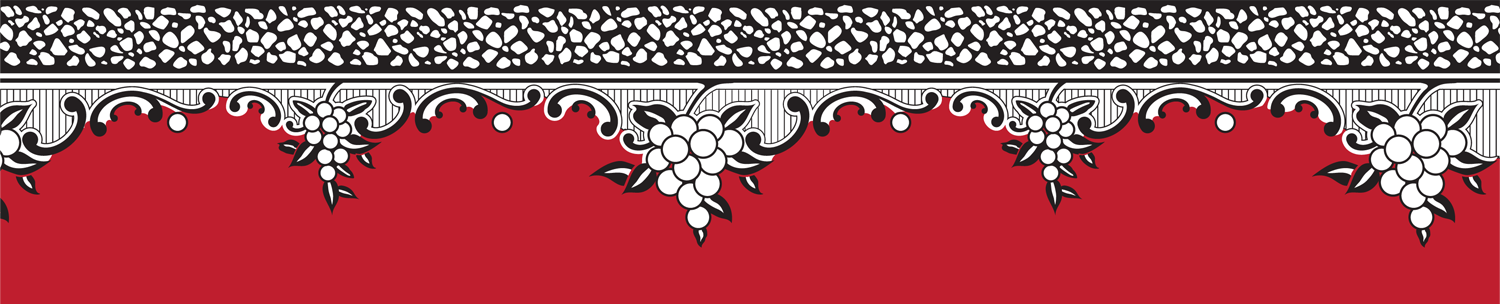
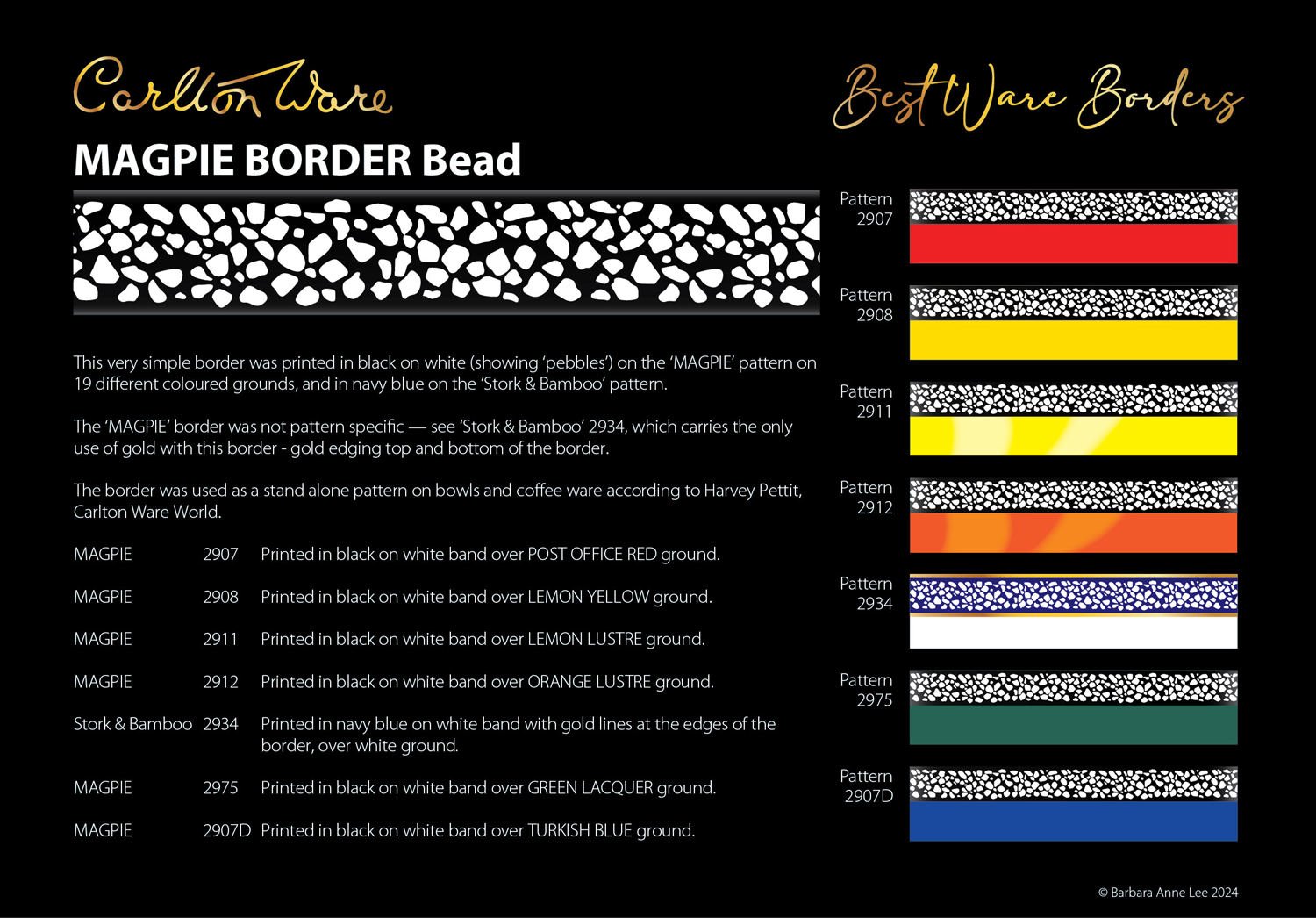
MAGPIE BORDER Bead
All examples of MAGPIE I have come across use only the simpler part of the border that is best named MAGPIE BORDER Bead, which again Barb has drawn for us below.
FULL MAGPIE BORDER
The FULL MAGPIE BORDER was used on its own, probably on plates or luncheon trays, though again I have not seen an example. Pattern records indicate that there was much experimentation with the choice of ground colours. Using another photograph from the records, Barb has redrawn the variant of the solitary border allocated the pattern number 2935 where the "berries" are painted in different coloured enamels.
Part MAGPIE BORDER
Around 1929, the fancy section of the full border was used on Carlton China, as you can see on the two examples below. The border is also known as Berry Cluster. China patterns followed a different sequence of pattern numbers, continuing the Birks Rawlins pattern book entries. To avoid confusion, china numbering had to be separate from the earthenware sequence. Again to avoid confusion, here I prefix china pattern numbers with the letter C.
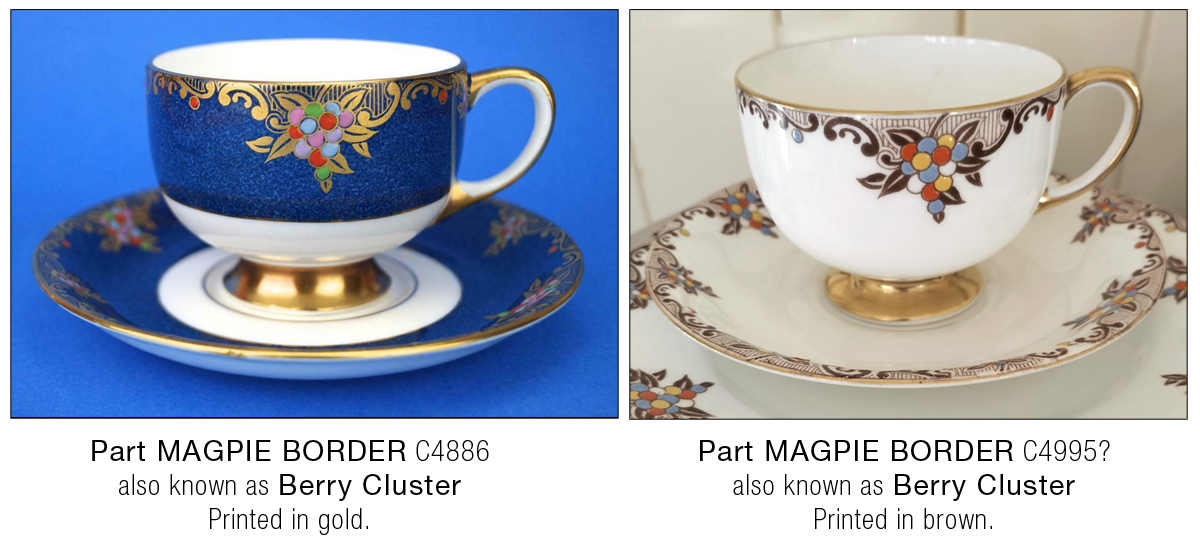
Image of C4995 courtesy of Katrina Wolff.
Though the border was devised by Enoch Boulton, Violet Elmer was responsible for the Carlton China patterns. Perhaps she had seen it in the pattern records and decided that it suited the china shapes, as it does, or perhaps Mr. Boulton — or one of the travelling salesmen — had suggested its use to her believing that it would appeal to customers.
Harvey Pettit
V2 March 2026. Carlton
China examples added, thanks to Barb'e eagle eye, and Katrina Wolff's post on
our sister Facebook Group.
If more information comes to light I will update this page.
Barb would like to thank the members of our companion Facebook Group who supplied good quality images to help her replicate the borders above.

The next article in this series is about Carlton Ware's CRETONNE pattern.