
Boulton's Birds - Part Six

The PARROT pattern
and its Border
By Enoch Boulton
by Harvey Pettitwith border artwork by Barbara Anne Lee
This is the sixth in a series of seventeen articles on bird patterns introduced by Enoch Boulton during his tenure as designer and decorating manager at the Carlton Works from 1921/22 to 1930.
Carlton Ware's buyers, primarily retailers, large and small, were presented with an astonishing twenty-seven variants of Enoch Boulton's PARROT pattern to offer their customers. These ranged from lavish gold-printed versions to the more affordable, but equally attractive alternatives printed in black.
The first in the list of offerings was pattern number 3016, which was printed in black against a LACQUER GREEN ground. This is shown below on a FOOTED FRUIT allocated the shape number 184.
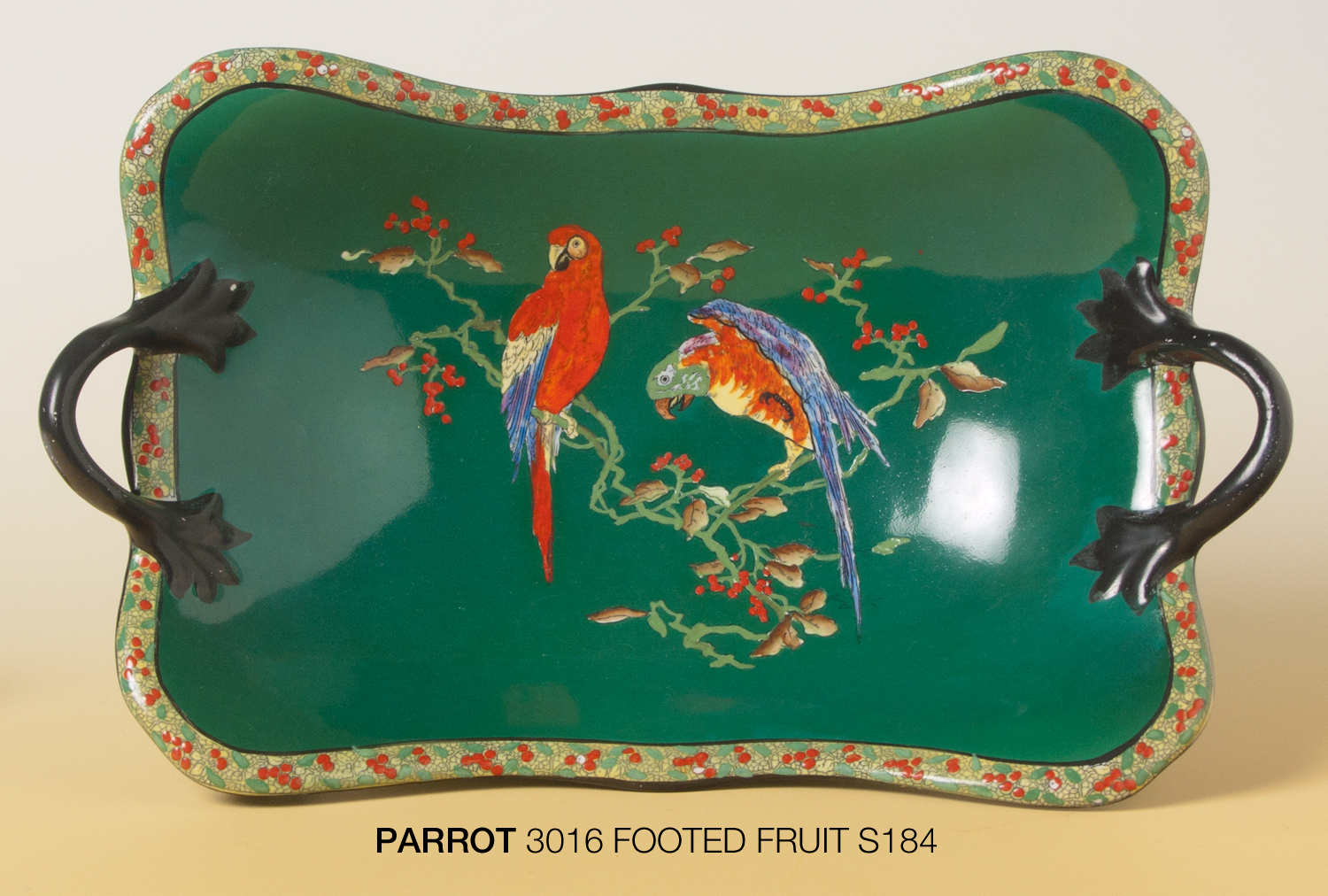
To view this fruit bowl fit your device's screen and/or enlarge,
click or tap on it.
To return to this page use your back button.
I estimate that Carlton Ware's PARROT pattern was introduced in 1925, at the same time as Stork & Bamboo, which I discussed in my previous article. Interviews I conducted with people who were employed at the Carlton Works during the 1920s and 1930s revealed that new patterns and ranges were introduced twice yearly. This would have kept designers, modellers, and engravers extremely busy.
Sometimes the black printed variants of the pattern were painted underglaze, while at other times they were decorated with on-glaze enamels. Below are two further examples.
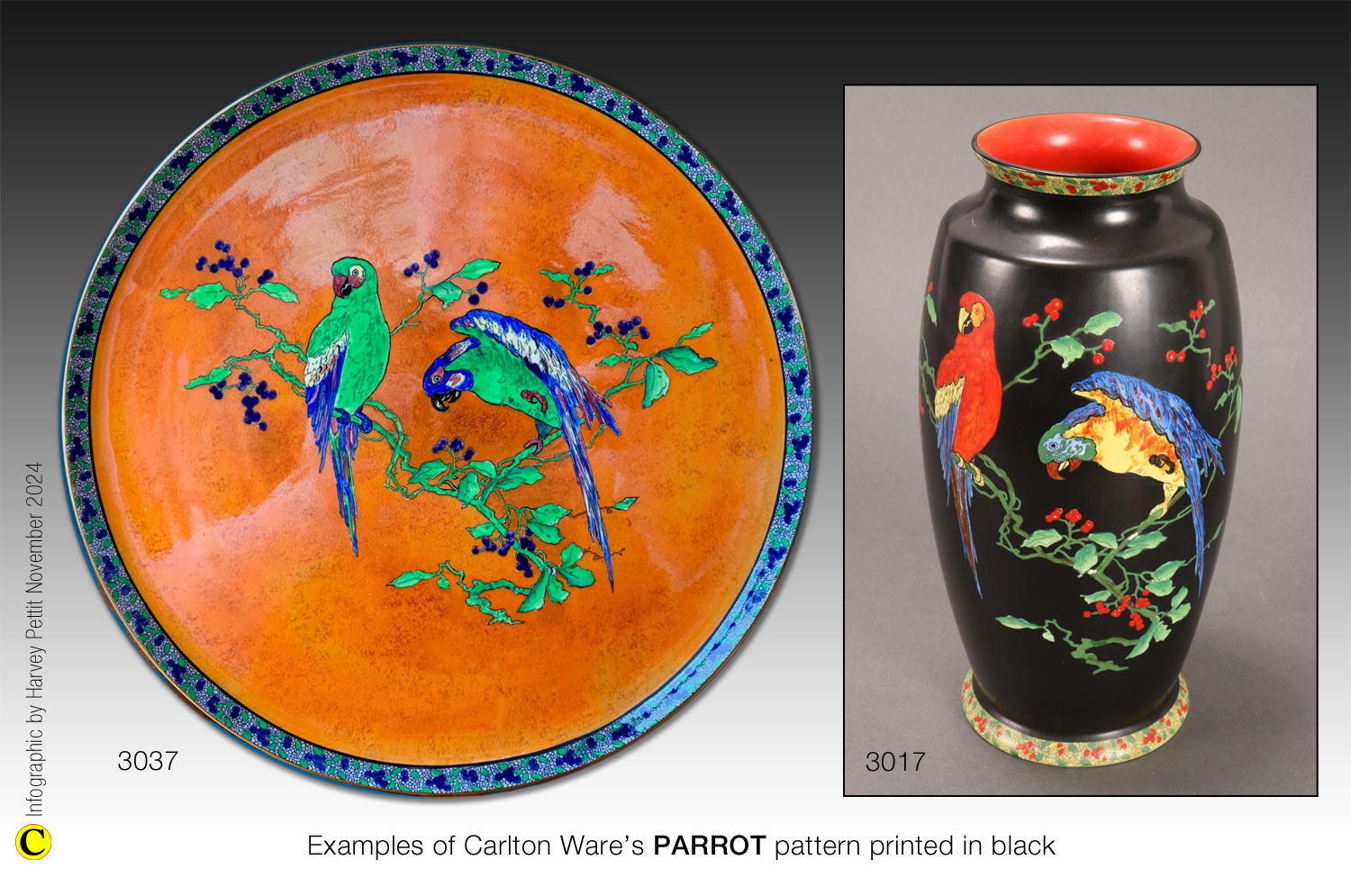
Right: PARROT 3017 vase S226 printed in black on a blown black ground with on-glaze enamels.
To return to this page use your back button.

on an ELECTRIC BLUE ground.
Of the twenty-seven variants of the pattern, seven were printed in gold.
The first of these gold-printed versions,
PARROT 3018, is shown on the right.
Notice that on different variants the birds are painted in different ways and colours so as to contrast well with the ground colour. On the gold-printed version shown here, one of the two parrots is painted in RUBY LUSTRE, which, as you can see, contrasts particularly well with its ELECTRIC BLUE ground.
To see the gold printed example fit your device's screen and/or to enlarge,
click or tap on it.
To return to this page, use your back button.
A likeness
In the summer of 2025 I came across a glass lampshade with a near-identical print of a parrot, probably made in Czechoslovakia in the 1920s. Below I show it compared with Enoch Boulton's design.
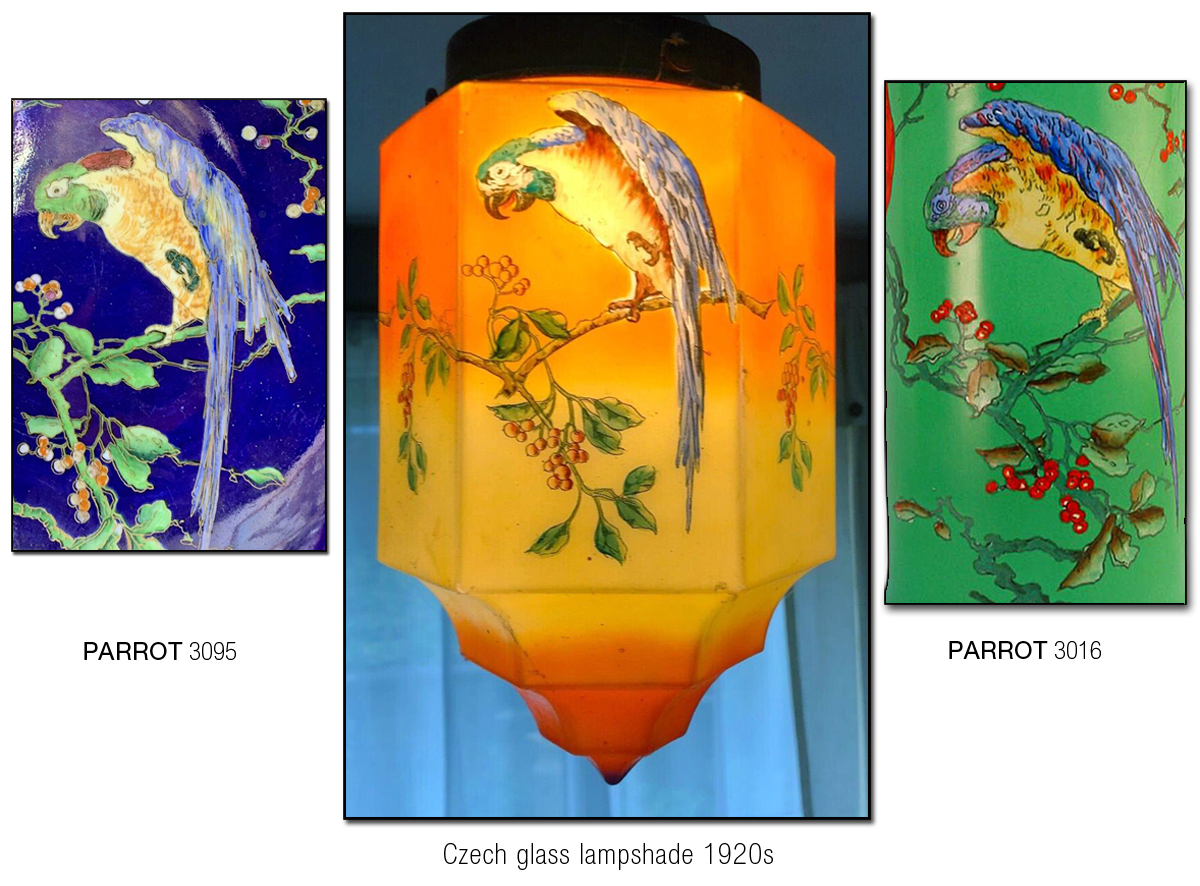
The similarity is so striking that it suggests to me that the lampshade was partially copied, with a second parrot added. It's unlikely that a Czech glass maker would have copied the parrot from Carlton Ware. Had the Wiltshaw family owned such a shade and Mrs Wiltshaw suggested it as a pattern, or had Boulton had one in his own home, or perhaps noticed it in a shop?
PARROT BORDER
Barb has redrawn the border specifically devised for the pattern. Below, she shows us the border as it would appear if printed in black as well as in gold.


Barb also shows us how some examples of PARROT BORDER were coloured, not only on their associated PARROT pattern but on others such as ORCHARD SPRAY 3042 and Embossed Plums 3052. These examples, as shown below, illustrate the striking colour combinations that Boulton chose.
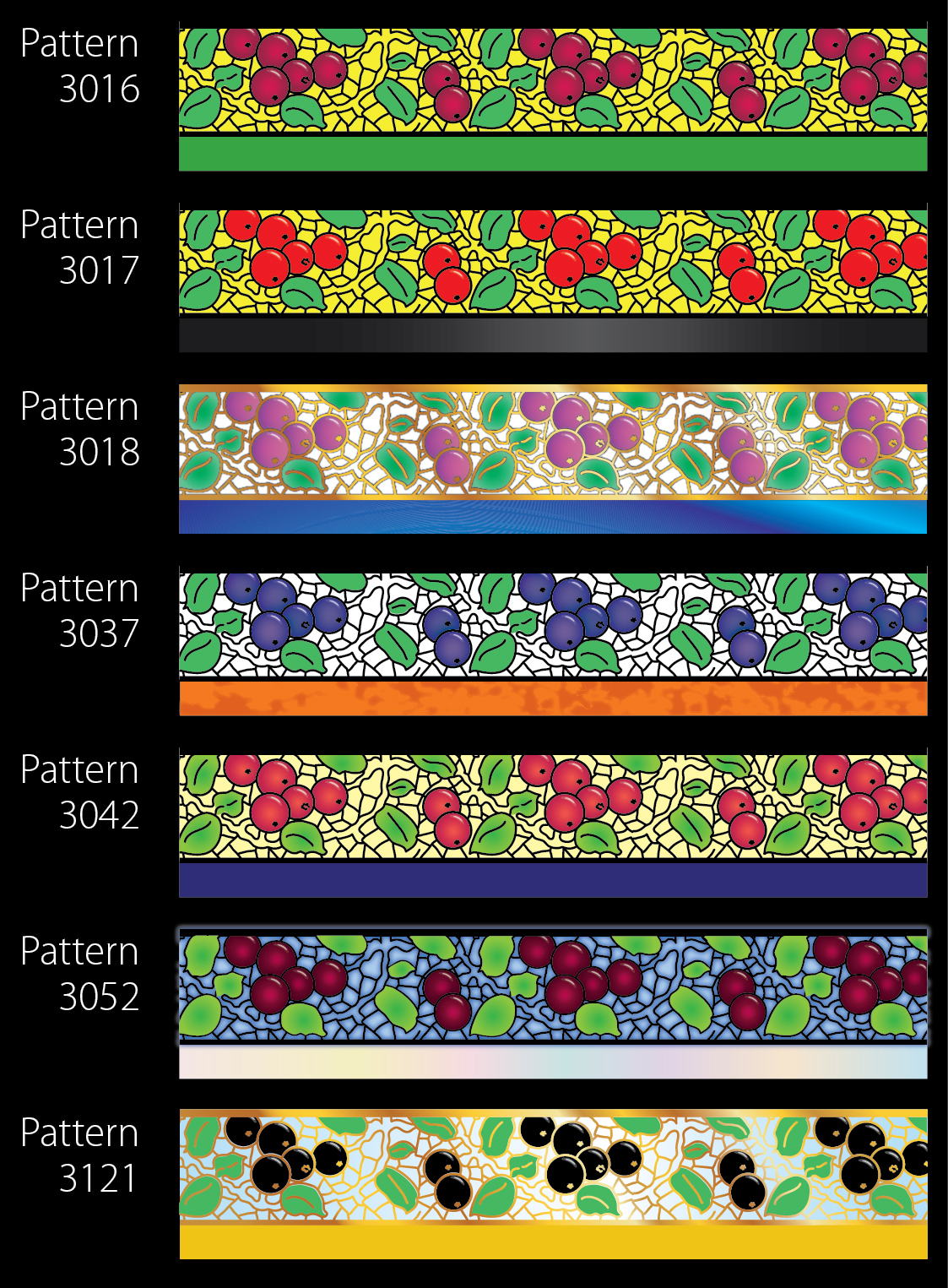
To view these examples fit your device's screen and/or enlarge, click or tap on them.
To return to this page use your back button.
I do not know how long the PARROT pattern was available, but I suggest that since most examples are found with the Crown backstamp, which was phased out around 1926 to be replaced by the script backstamp, it may have been available for only about three years. Carlton Ware's continuing success depended on a constant stream of new patterns to offer their customers. Consequently, older patterns and ranges would be discontinued to make way for new ones. This was aside from a few of the stalwart Chinoiserie patterns, one of which remained in production for more than forty years.
HarveyBarb would like to thank the members of our companion Facebook Group, who supplied good quality images to help her replicate the borders above.
V2 March 2026 - added discovery of a near-identical pattern on a Czech glass lampshade. If more information comes to light, I will update this page again.

The next pattern in this series of articles is about Carlton Ware's Bird & Pinecone pattern.