
Boulton's Birds - Part Thirteen
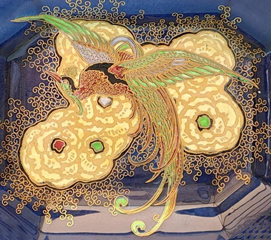
CHINESE BIRD & CLOUD
Designed by Enoch Boulton
by Harvey Pettitwith border artwork by Barbara Anne Lee
This is the thirteenth in a series of seventeen articles on bird patterns introduced by Enoch Boulton during his tenure as designer and decorating manager at the Carlton Works from 1921/22 to 1930.
Continuing Flights of Fantasy
CHINESE BIRD & CLOUD elaborates on CHINESE BIRD, its sister pattern, which I focused on in the previous article. It appears to have been introduced a year later and is another extravagant concoction, incorporating the "cloud" motif originally devised for the even earlier SWALLOW & CLOUD pattern.
Pictured below is what Carlton Ware called its OCTAGON CAKE (tray) decorated with CHINESE BIRD & CLOUD 3274. This first variant of the pattern employs an unusual freehand-painted background resembling pebbles or crazy paving in vibrant semi-matt blues. When space permitted—as in this example—the CHINALAND TREE, part of Carlton Ware's exotic CHINALAND pattern, accompanied the ethereal fowl.
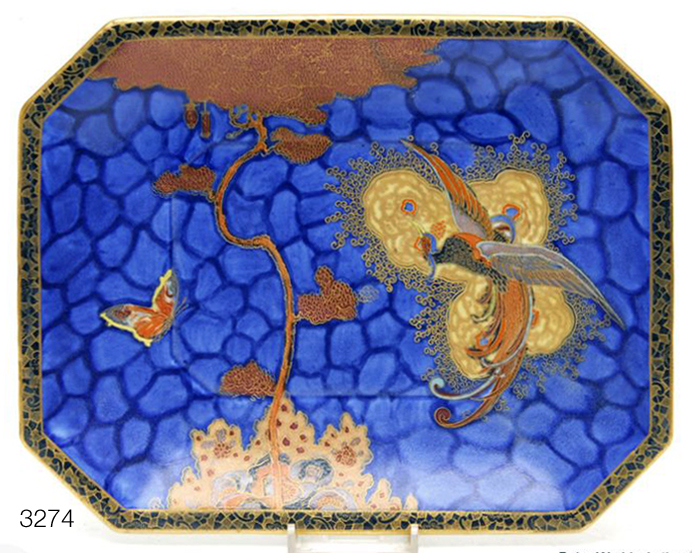
Freehand painted ground in semi-matt blues; underglaze printed and painted;
onglaze ruby lustre; raised enamels; reprinted in gold.
To return to this page, use your back button.
The CHINALAND TREE
Carlton Ware's
CHINALAND
pattern was introduced around 1926, roughly two years earlier, and was
perhaps Enoch Boulton's most complex composition.
It incorporated elements from numerous other Chinoiserie patterns, setting them against blue seas and a
skyline of snow-capped mountains.
Another element of this refined Chinoiserie pattern was the
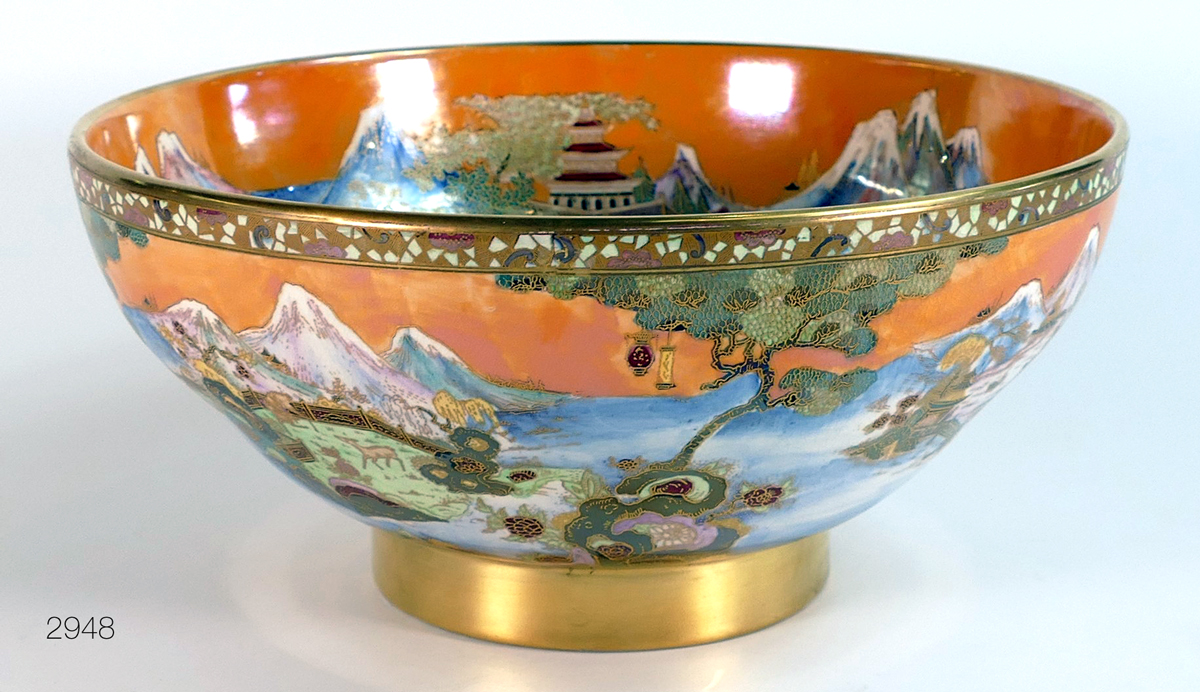
CHINALAND TREE
distinguished by its two hanging lanterns. The tree’s height could be
cleverly adjusted—trimmed or extended—to suit a particular shape. Usually, it emerged from stylised rocks (gongshi), flowers,
and foliage—or was omitted altogether if there was no space, as you can see later in this article.

Shown below is the much-prized CHINALAND OXFORD shape bowl, displaying its namesake tree. This special pattern remained available by special order well into the 1960s.
To return to this page, use your back button.
The OCTAGON CAKE tray pictured at the beginning of this article shows the CHINALAND TREE with its gongshi in all its glory, accompanied by a butterfly. Fluttering insects were often used to populate sparse areas and were placed at the discretion of the transferer. Occasionally, they concealed minor flaws in the ground; however, in this instance they were clearly added to balance the composition.
Variants
A total of nine variants was recorded in Carlton Ware's pattern records.
The second variant, shown below, was assigned the consecutive pattern number 3275.
As with its predecessor, it too was given a freehand-painted background, this time of random brushstrokes in a semi-matt ochre colour. Notice that the rim of the vase employs different borders
inside and outside. More on this later.
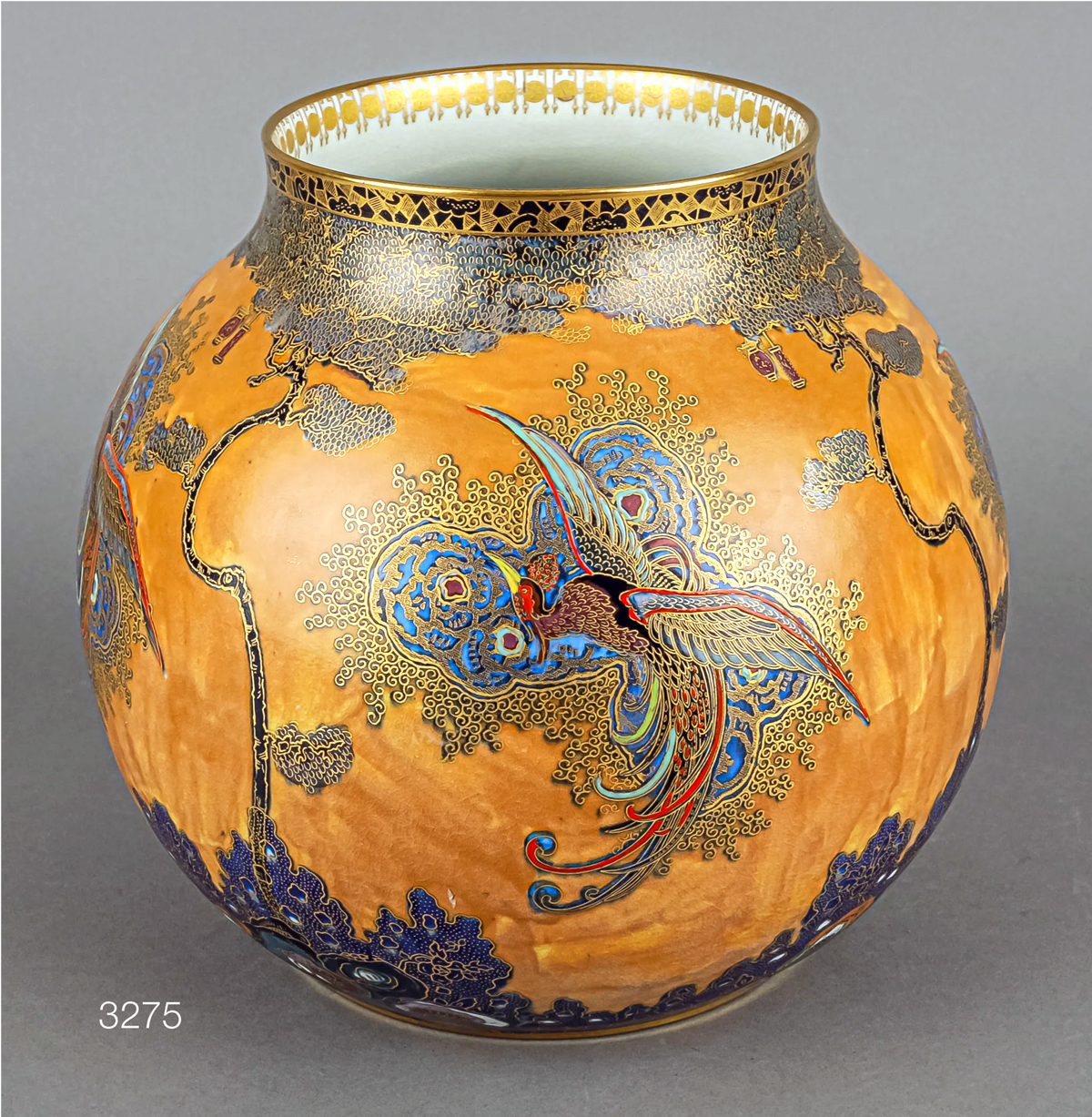
Freehand painted ground of brushstrokes in matt YELLOW (ochre); underglaze printed
and painted; onglaze ruby lustre detail; raised enamels; reprinted in gold.
To return to this page, use your back button.
Another and slightly later variant, pattern number 3327, uses a POWDER BLUE ground and is mostly decorated underglaze but with a touch of onglaze RUBY lustre detail to the cloud and the bird's elaborate wings. On this example, vase shape number 406, there was no space for the tree—not even on the reverse.
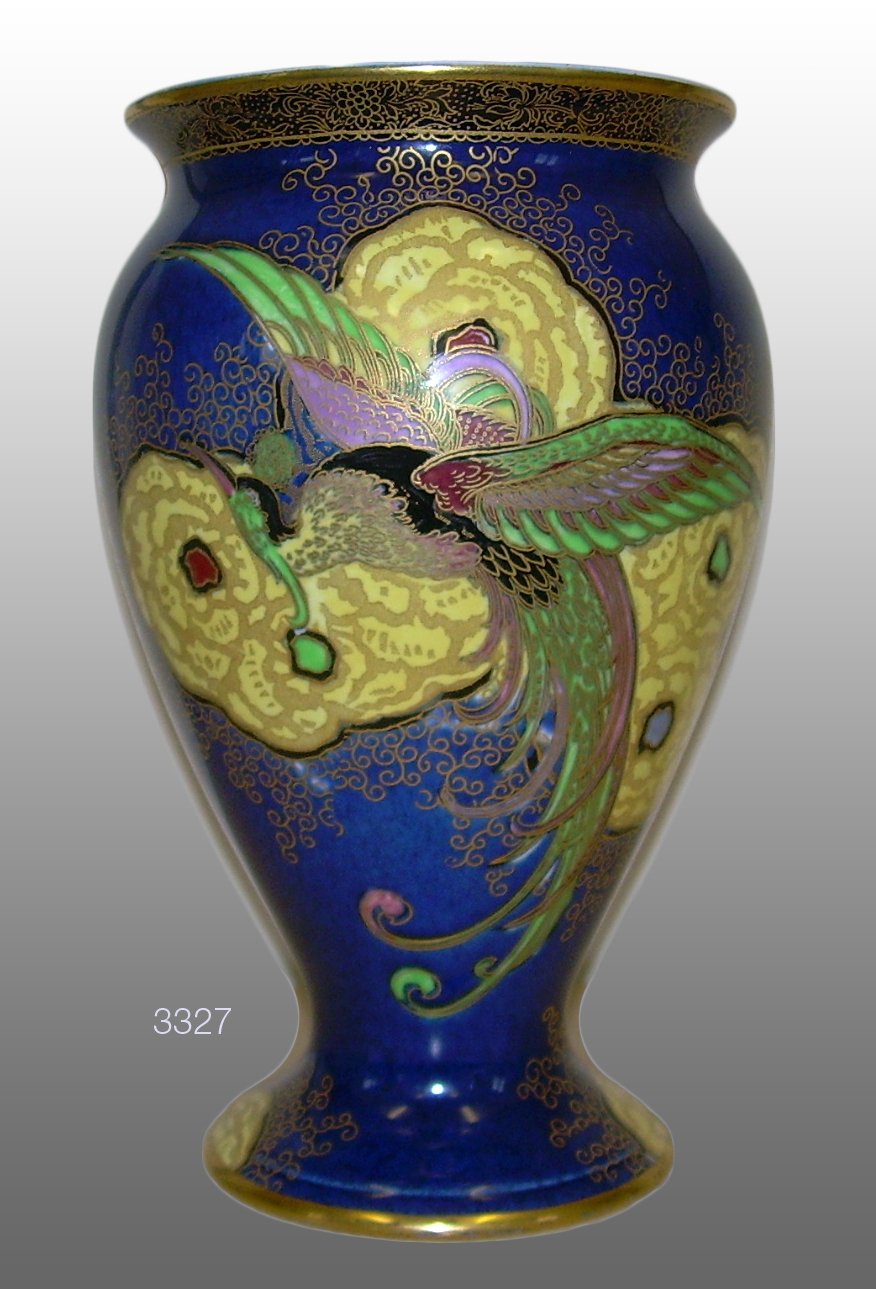
underglaze printed and painted; onglaze ruby lustre detail; reprinted in gold.
To return to this page, use your back button.
You can read about a probable source for the 'cloud' motif in my article on PARADISE BIRD & TREE with CLOUD
Borders
CHINESE BIRD & CLOUD used a border and "bead" devised for two of Horace Wain's Chinoiserie patterns, specifically MIKADO and TEMPLE. Horace Wain preceded Enoch Boulton as designer and decorating manager. Carlton Ware used the term 'bead' to describe a narrow border, often forming part of a wider one.
Firstly, TEMPLE BEAD, gold-printed on a black ground, which is used on the first two examples above, pattern numbers 3274 and 3275.
 © Barbara Anne Lee 2023.
Secondly, MIKADO BORDER BEAD, also gold-printed on a black ground, as on the example with the POWDER BLUE ground, pattern number 3327.
 © Barbara Anne Lee 2023
At times, a different border was applied to the internal rims of vases. On the globular vase illustrated above, the WHEEL BORDER is employed, as drawn by Barb below. Read more about widely used, ubiquitous borders.
 © Barbara Anne Lee 2023
To enlarge Barb's image of these
borders and beads, click or tap on them.
Use your back button to return to this article.
Date of Introduction
The first variant of CHINESE BIRD & CLOUD was probably introduced in late 1928. According to Miss Elmer, who succeeded Enoch Boulton as designer, new patterns and shapes were introduced twice yearly and promoted at trade fairs, particularly at the annual British Industries Fair, held in London and Birmingham.
Availability
Carlton Ware's pattern records list a total of nine variants of
CHINESE BIRD & CLOUD.
The first was 3274, shown at the top of this article. The last was 3400, which had a JAP BLUE and
OVEN BLUE ground.
As with
CHINESE BIRD,
it is likely that, due to their complexity,
CHINESE BIRD & CLOUD
patterns were discontinued by the late 1930s, or perhaps earlier.
The Second World War (1939–1945) would certainly have curtailed such elaborate decorations.
In any event, a pattern would remain in production as long as demand existed and as long as it remained
economically viable. Versions of
MIKADO, for example,
remained in production for nearly seventy years after its introduction in 1920.
© Harvey Pettit 2025
V1 December 2025.
If new or more accurate information comes to light, I will update this page.

The next article in this series is about the
TREE & SWALLOW. pattern.