
Boulton's Birds - Part Fifteen
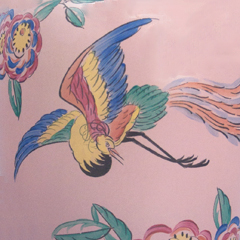
NEW CHINESE BIRD
Designed by Enoch Boulton
by Harvey Pettitwith border artwork by Barbara Anne Lee
This is the fifteenth in a series of seventeen articles on bird patterns introduced by Enoch Boulton during his tenure as designer and decorating manager at the Carlton Works from 1921/22 to 1930.
Handcraft
NEW CHINESE BIRD was part of Carlton Ware's HANDCRAFT range, which Enoch Boulton introduced in 1928. No doubt this new range was a response to the growing fashion for freehand-painted decorations that Gray's Pottery and Carter Stabler & Adams (Poole Pottery from 1934), in particular, had made popular in the early to mid-1920s. Some of the patterns in the HANDCRAFT range may well have run into the later part of the 1930s; some may have only been available for a year or two, depending on demand from retailers.
Matt Matters
One of the defining characteristics of the HANDCRAFT range was its use of matt glazes, which have a smooth, silky appearance, as you can see from the image below. In the early part of the twentieth century, such finishes tended to be the domain of studio potters.

BAINES CRIMSON ground; MATT GLAZE; pattern printed in black on-glaze;
handpainted in matt colours.
To return to this page, use your back button.
The style of NEW CHINESE BIRD is very different from Boulton's more precise and elaborate BEST WARE patterns. The pattern is deliberately made to appear entirely freehand painted, but, cleverly, it is not. It was first printed in black and then hand painted in a range of colours, giving a convincing impression of being freehand. Most HANDCRAFT patterns, however, were entirely freehand painted.
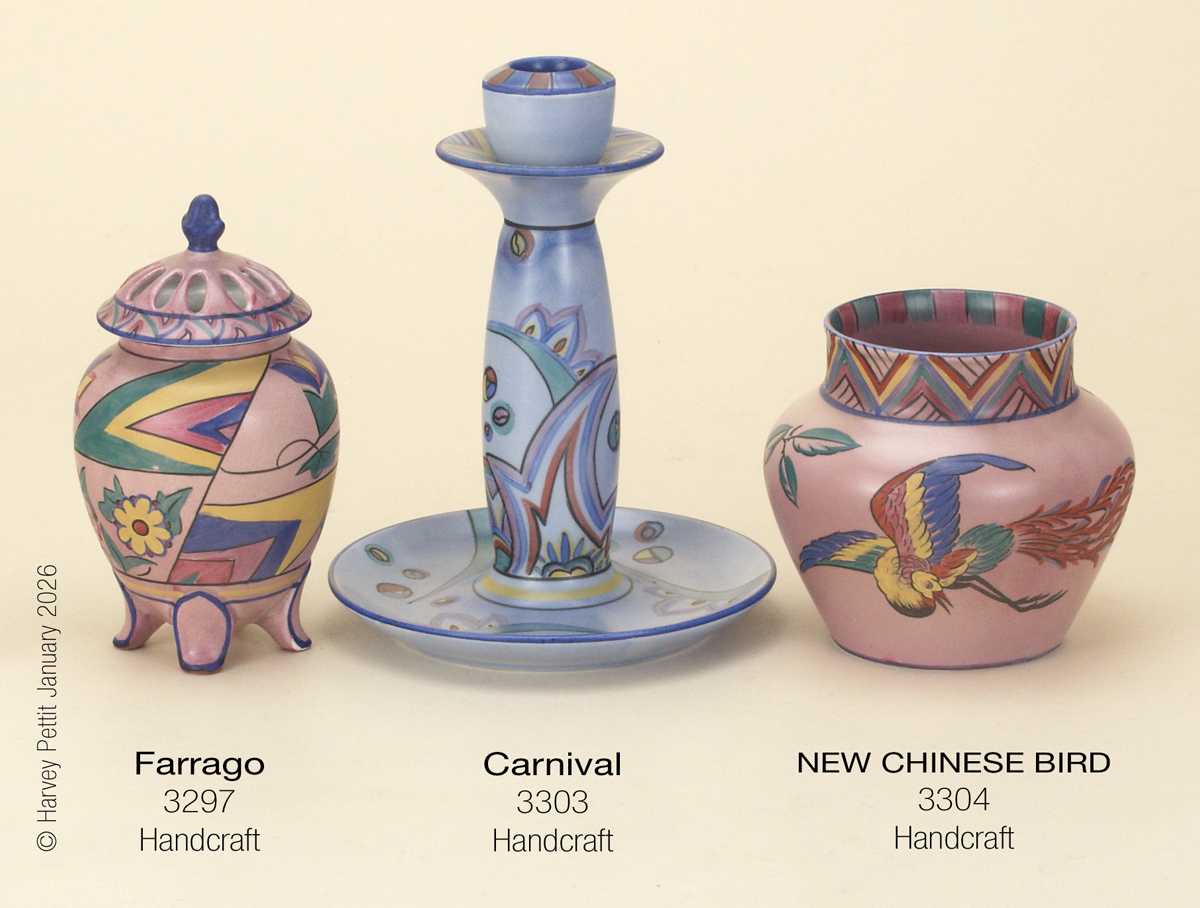
Below I show two other examples from the HANDCRAFT range alongside a different NEW CHINESE BIRD vase—the Farrago pot-pourri uses the same colours. Their borders, sized to suit each shape, are also freehand painted.
To return to this page, use your back button.
Borders
The freehand-painted border used with the pattern takes two forms: either a dentil (tooth-like blocks) or zig-zag. Barb has redrawn these for us below—dentil followed by zig-zag.
 © Barbara Anne Lee 2026
 © Barbara Anne Lee 2026
Date of Introduction & Availability
NEW CHINESE BIRD was probably introduced in early 1929. New patterns and shapes were introduced twice yearly and promoted at trade fairs, particularly at the annual British Industries Fair held in London and Birmingham.
There was only one version of
NEW
CHINESE BIRD—the one shown here.
It may have been available only for a short time, as suggested by how few examples are found today.
However, the pattern print and its accompanying flowers and leaves were used again,
with Boulton's ubiquitous cloud, as employed on some of his other bird patterns, to create
NEW CHINESE BIRD & CLOUD,
the subject of my next article.
© Harvey Pettit 2025
V1 January 2026.
If new or more accurate information comes to light, I will update this page.
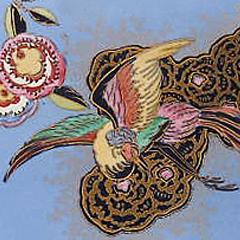
The next article in this series is about the
NEW CHINESE BIRD & CLOUD
pattern.