
Boulton's Birds - Part Seventeen

BIRD & FLOWER
Also known as
Feathertailed Bird & Flower
Designed by Enoch Boulton
by Harvey Pettitwith border artwork by Barbara Anne Lee
This is the seventeenth and final article in a series on bird patterns introduced by Enoch Boulton during his tenure as designer and decorating manager at the Carlton Works from 1921/22 to 1930.
Cloud Nine
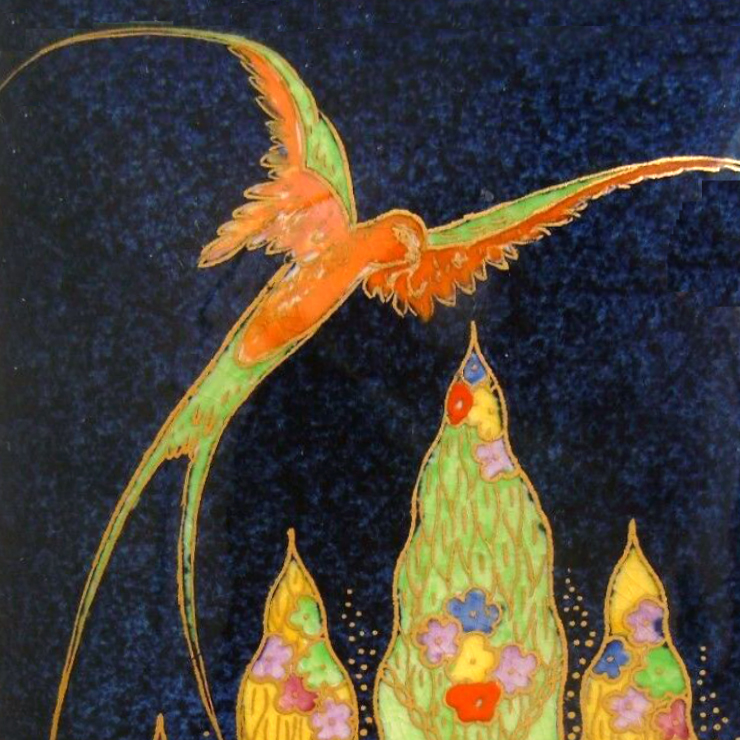
BIRD & FLOWER was Enoch Boulton's last bird pattern before he left the Carlton Works in late 1929 or early 1930 to work for Fielding's. Before its proper name was known, collectors referred to it as Feathertailed Bird & Flower. The lavish tail of the bird is similar to that in his earlier CHINESE BIRD pattern. Once again, Boulton employs his cloud motif, originally devised for his even earlier SWALLOW & CLOUD pattern from 1926. This time, however, the wide, filigree-like fringe to the cloud is omitted; instead, the cloud is edged with a simple gold line, painted freehand. In this instance, the cloud, printed as a sheet—possibly from a roller, like wallpaper—is first cut out with convex or concave scalloped edges to suit the contours of the shape being decorated; it is then traced or edged with a gold line. Aside from their decorative function, gold lines concealed the welt or join between the cut-out print and the background, which could sometimes be uneven. The print of the cloud was also cut into strips to form the border. The transferer's contribution to decorating techniques is often underappreciated; far more skill was needed than meets the eye to ensure an eye catching fit to a particular shape.
Pictured below, is the angular jug shape S493 decorated with BIRD & FLOWER 3354. This first variant of the pattern employs a stippled TURQUOISE BLUE ground with a MATT GLAZE and a BLACK cloud.
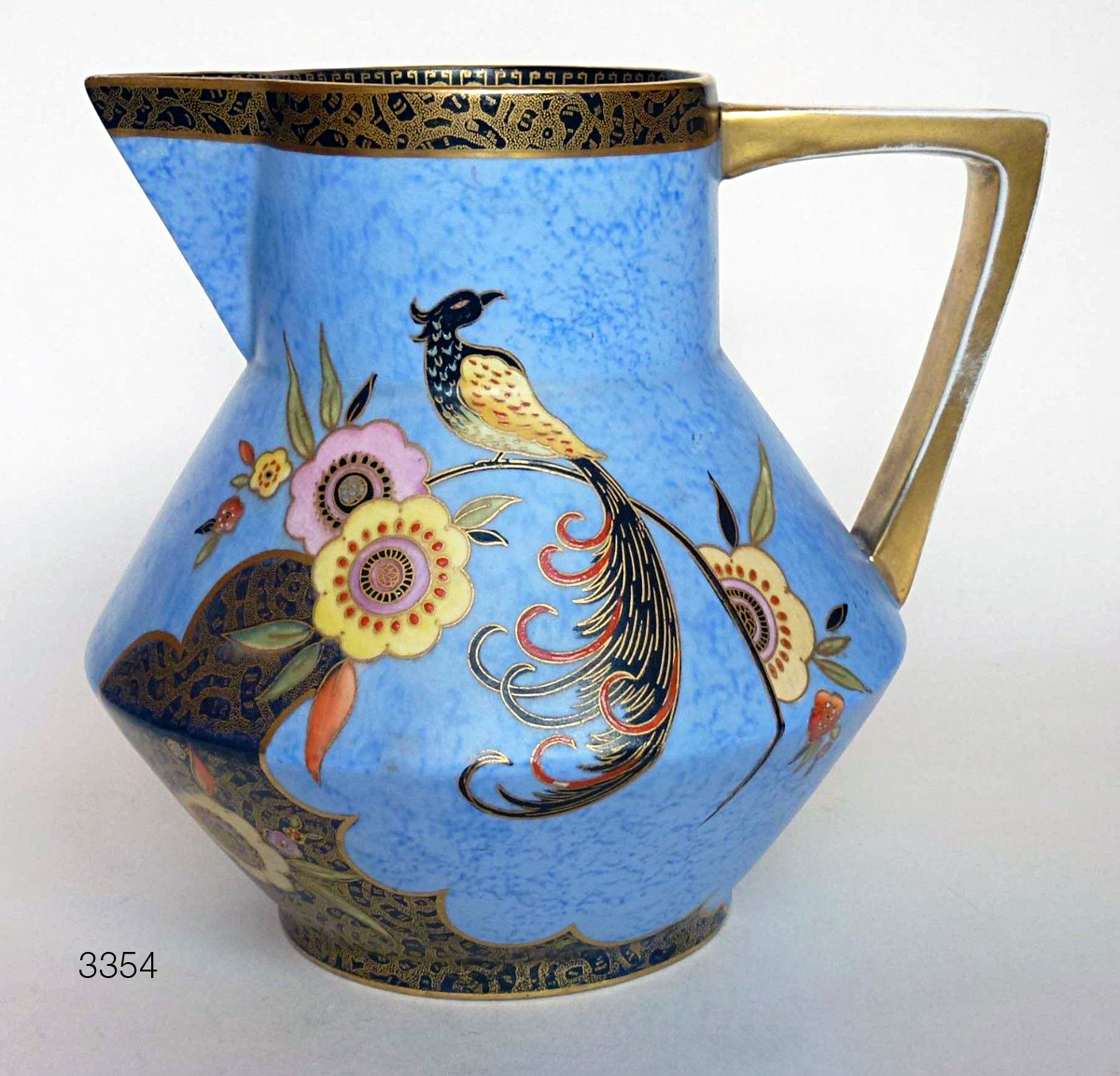
MATT GLAZE; underglaze printed and painted; reprinted in gold; raised enamels.
To return to this page, use your back button.
Variants
Six variants were recorded in Carlton Ware's pattern records. The second, shown below, was assigned the consecutive pattern number 3355. As with its predecessor, it too was given a MATT GLAZE, this time over a stippled GREEN ground.
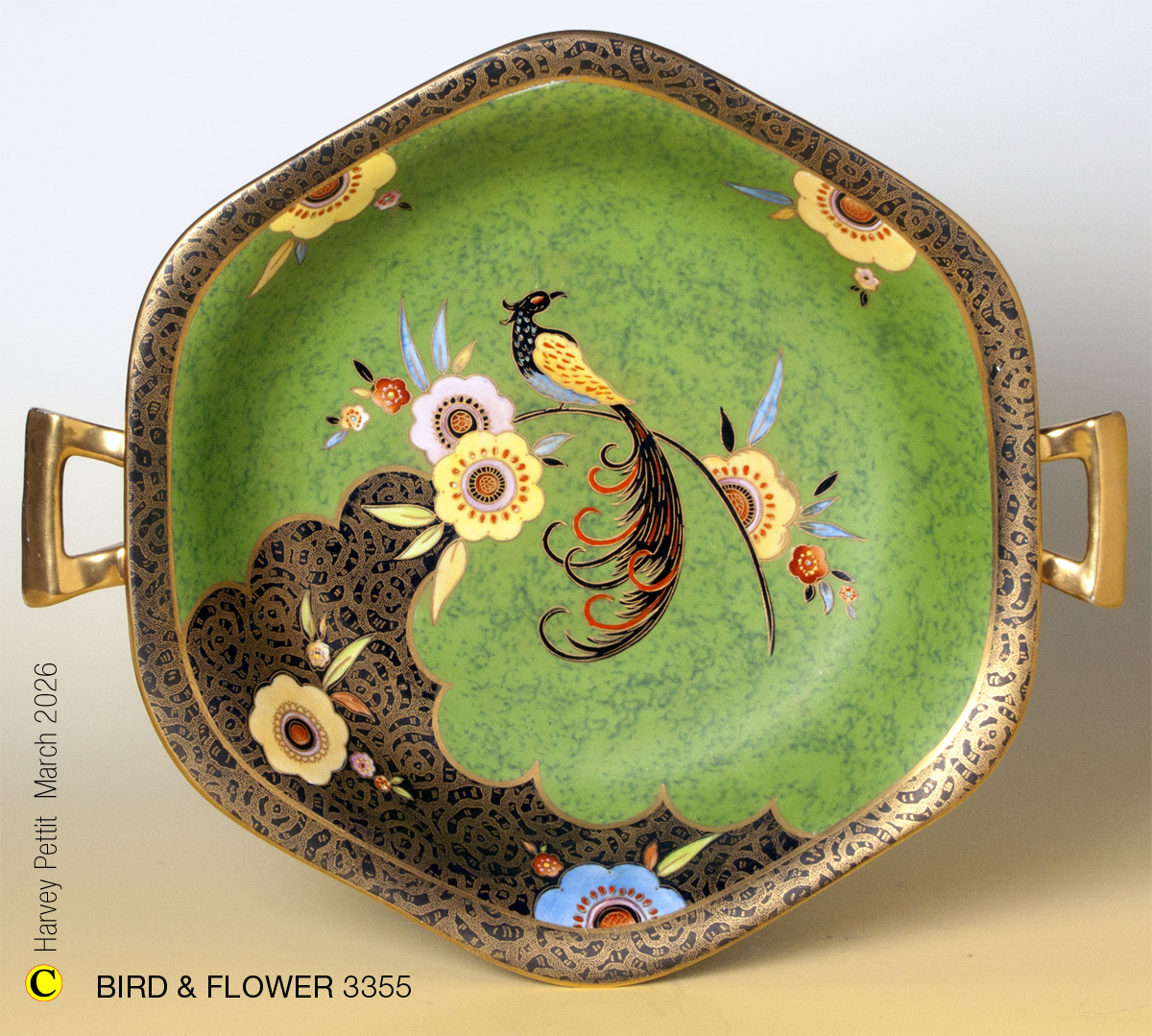
Stippled GREEN ground; BLACK cloud; MATT GLAZE; underglaze printed and painted;
reprinted in gold with raised enamels.
To return to this page, use your back button.
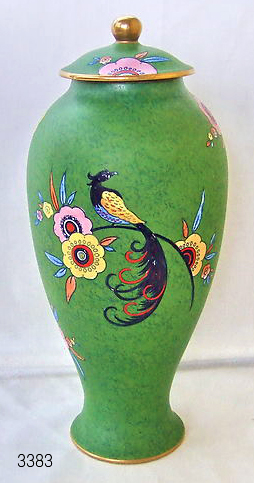
A simplified version of the pattern was offered to
customers with less deep pockets. It was printed in black and omitted the print
of the cloud and border. I show an example on the right on a covered vase, shape
S166. It was allocated the pattern number 3383.
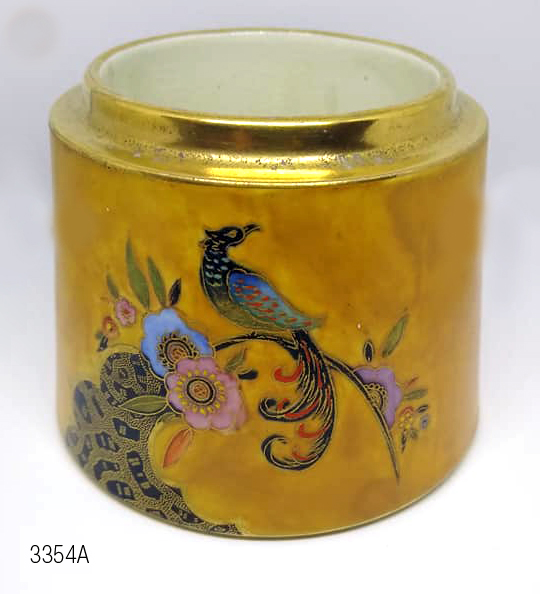
for GB & Sons.
Another variant, 3354A, was the same as 3354 except it used a YELLOW ground, which appears as an ochre colour. (Pattern numbers with an alphabetical suffix were often added at a later date, denoting new colourways or minor revisions, though this is not the case here). The example on the left, a cigarette jar missing its lid, was produced for GB & Sons, and this particular colourway may well have been reserved for that high-end manufacturer, who supplied up-market retailers with luxury goods.
Pattern 3395 had a CELADON GREEN ground, whilst the last variant, 3446, had a JADE GREEN ground with a MATT GLAZE.
These last two pattern numbers fall within Violet Elmer's tenure as designer of Best Ware, so their colourways are likely to be by her unless they were already on the table when Boulton left and were then taken forward by the new designer. I do not have examples of these last two variants to show, but if you have one, I can easily insert an image of it here. You can contact me through our sister group Carlton Ware World on Facebook.
Borders
BIRD & FLOWER did not have a dedicated border, as many other patterns did. Instead, it used the cloud print cut into strips, which Barb has drawn for us.
Cloud Border
 © Barbara Anne Lee 2026
A different border was often applied to the internal rims of vases. Horace Wain's
WHEEL BORDER
was frequently used, as redrawn by Barb below.
Read more about widely used, ubiquitous borders.
WHEEL BORDER
 © Barbara Anne Lee 2023
To enlarge Barb's image of these borders,
click or tap on them.
Use your back button to return to this article.
Date of Introduction & Availability
BIRD & FLOWER patterns were introduced between 1929 and 1930. As with most patterns, we can only guess for how long they remained available. They may have been offered for only two or three years; certainly they would have been discontinued by the latter part of the 1930s. As new patterns were introduced, older ones were discontinued unless they were particularly popular with retailers, who liked to offer customers something new each season. Hence the constant stream of new patterns from the Carlton Works.
BIRD & FLOWER
was Enoch Boulton's last bird pattern for Carlton Ware;
he was soon to leave to work for Fielding's, makers of Crown Devon, doing so either in late 1929 or early 1930.
You can read about his departure below.
My next series of articles will be on bird patterns by Violet Elmer, who suceeded Enoch Boulton as designer of Best Ware in 1930.
Background to Boulton's departure
The information I provide below about Boulton's departure mostly stems directly from conversations and interviews I conducted during the 1980s with many former Carlton Ware employees who had worked at the Carlton Works during the 1920s and 30s, all now sadly departed. My writing on the extraordinary pottery they created is dedicated to them.
A year or two before Enoch Boulton left Copeland Street, Carlton Ware's
long-standing salesman, George Barker, left the Carlton Works after a disagreement with Cuthbert Wiltshaw,
the Pottery's owner.
Barker, described by all as a gentleman and a highly respected and successful sales manager, had been with Carlton Ware for many years.
In 1918, it was he who identified Fred Wiltshaw’s body after the Pottery’s founder died from severe
injuries sustained when he fell between a moving train and the platform at Stoke Railway Station.
In carrying out the difficult duty of identification, Barker stood in place of Cuthbert, Fred’s eldest son, who was
serving in the Royal Flying Corps/RAF during the First World War and was possibly on reconnaissance
flights to France at the time.
Barker left Copeland Street to work for Fielding's, makers of Crown Devon and one of Carlton Ware's competitors.
Having worked with Boulton ever since the young designer joined Carlton Ware in 1921/22, Barker knew how
talented he was and persuaded the now highly experienced designer and decorating manager to leave the Carlton
Works for Fielding's. The offer of a higher salary was the main incentive. Enoch had recently married
and therefore had new responsibilities, especially with a baby on the way.
As Carlton Ware's salesman for many years, Barker, as did Boulton, knew only too well which of
the pottery's lines were good sellers, and so, for his new masters, Abraham and his son Alec Ross Fielding,
Boulton replicated popular shapes he had devised at Copeland Street. In particular, the highly successful
LETTUCE & TOMATO
range, and a number of Best Ware shapes. He also introduced his new employer
to some of Carlton Ware's closely guarded decorating techniques, notably the application of
RUBY LUSTRE
and
POWDER BLUE
grounds.
As importantly for Fielding's sales, Barker knew all of Carlton Ware's customers, whom he had cultivated over years.
Inevitably, he will have tried to persuade them to move from selling Carlton Ware to selling Crown Devon.
Combined with Fielding's policy of undercutting on prices (within the Potteries, Crown Devon was sometimes called
"poor man's Carlton Ware") and the economic crisis triggered by the Wall Street Crash in 1929, there was a real
threat to Carlton Ware's survival. This was compounded by Carlton Ware’s recent — and, with hindsight, untimely
— expansion through the purchase of the China Works of Birks Rawlins in 1928. On top of all this, in a terrible
moment of panic and in error, Carlton Ware's bank was soon to place the Pottery into receivership.
How on earth did Carlton Ware survive all of these colliding, adverse events? Enter Violet Elmer…
© Harvey Pettit 2026
V1 March 2026.
If new or more information comes to light, I will update this page.